
H. Jester Fieldstone — The Writer Behind the Books
H. Jester Fieldstone has a particular fascination with people who promise to save the world, especially when they appear determined to save it from itself.
His writing explores the curious relationship between political power and human behavior: why intelligent people embrace improbable claims, why loyalty sometimes survives overwhelming evidence, and why the most confident voice in the room so often becomes the most persuasive.
Fieldstone approaches these questions with a mixture of satire, skepticism, psychological observation, and an appreciation for the absurdities of public life. His work examines the distance between what people believe, what they are told, and what they are willing to accept as truth.
Across three books, he has employed three distinct literary approaches. The Extraordinary Voyages of Donald J. Trump uses satire to expose political absurdity. We Is Trump investigates the identity and psychology of a political movement. The Phantom Leviathan carries these concerns into historical fiction, where an obsessive sea captain leads his crew in pursuit of an enemy whose existence remains uncertain.
Fieldstone's books invite readers to laugh, question, reconsider, and occasionally recognize something uncomfortably familiar.
After all, the strangest characters in fiction sometimes bear an extraordinary resemblance to people we have already met.
The Journey Behind the Books
H. Jester Fieldstone's journey through three literary forms began with a simple observation: sometimes political reality is so absurd that satire seems the most reasonable response.
The Extraordinary Voyages of Donald J. Trump emerged from that perspective, using humor and exaggeration to explore the peculiar spectacle of modern political life. But behind the comedy lay more serious questions. What accounts for the extraordinary loyalty some leaders inspire? Why do contradictions that might destroy one politician's career seem only to strengthen another's following?
Those questions led to We Is Trump, a more analytical examination of the psychological and social forces that bind individuals to political movements.
With The Phantom Leviathan, Fieldstone turned to fiction, allowing characters and their choices to explore what political analysis could only describe. A nineteenth-century sailing vessel became the setting for a story about authority, human weakness, and the consequences of collective belief.
Three different approaches emerged from a continuing curiosity about human nature—and the suspicion that understanding those who follow may be every bit as important as understanding those who lead.
Three Books, Three Perspectives
Political power has many faces, and H. Jester Fieldstone has chosen three very different ways to examine them.
Through satire, political analysis, and historical fiction, his books explore the peculiar relationship between leaders and followers, the appeal of improbable promises, and the remarkable human capacity to believe what we wish were true.
The Extraordinary Voyages of Donald J. Trump invites readers to laugh at political absurdity. We Is Trump examines the psychology of collective allegiance. The Phantom Leviathan transforms these concerns into a maritime allegory of obsession and obedience.
Three books, three perspectives, and one enduring question: Why do we follow?
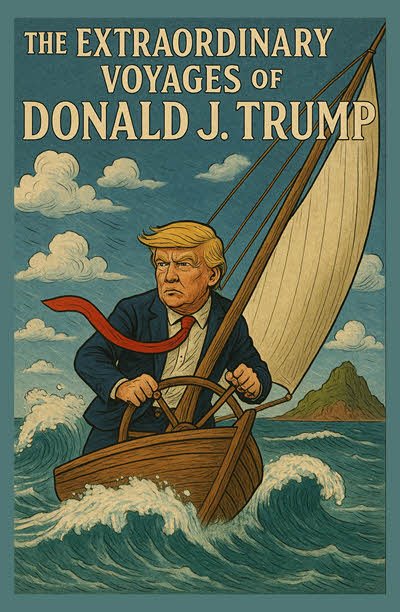
The Extraordinary Voyages of Donald J. Trump
Book One of the H. Jester Fieldstone Trilogy — Political Satire
In a world where every setback becomes a triumph, every boast grows larger with repetition, and reality struggles to keep pace with political imagination, H. Jester Fieldstone discovers that satire may be the only sensible response.
In The Extraordinary Voyages of Donald J. Trump, H. Jester Fieldstone unleashes his satirical imagination upon the remarkable world of Donald Trump, where exaggeration is an art form, self-promotion knows no boundaries, and the improbable becomes almost indistinguishable from the everyday.
With biting humor, inventive storytelling, and an eye for political absurdity, Fieldstone takes readers on a journey through a world where confidence routinely outruns competence and every misadventure becomes another magnificent triumph.
The first book in a thematically connected trilogy, this entertaining political satire sets the stage for We Is Trump and The Phantom Leviathan, three distinct literary explorations of power, persuasion, and the extraordinary relationship between leaders and those who follow them.
Discover the satire. Enjoy the absurdity. And remember: reality may be stranger than fiction, but fiction has the advantage of admitting what it is.
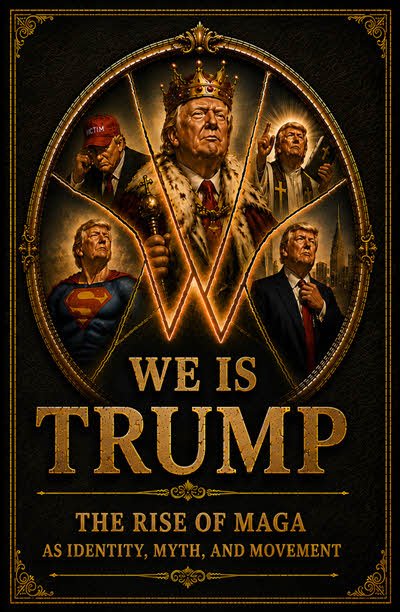
We Is Trump
Book Two of the H. Jester Fieldstone Trilogy — Political and Social Analysis
The MAGA movement is more than a collection of political opinions. For many of its adherents, it has become a source of identity, belonging, and personal conviction. We Is Trump investigates the forces that make such allegiance powerful—and sometimes remarkably resistant to contradiction.
In We Is Trump, H. Jester Fieldstone moves beyond the satire of his first book to investigate the remarkable psychological, cultural, and political forces behind Donald Trump and the MAGA movement.
With penetrating analysis, historical perspective, and occasional flashes of irreverent humor, Fieldstone examines the grievances, loyalties, fears, and shared convictions that bind millions of Americans to a political identity. Why does allegiance survive contradiction? How does personal loyalty become a measure of belonging? And what happens when political conviction becomes inseparable from personal identity?
The second book in a thematically connected trilogy, We Is Trump explores the human behavior behind the political spectacle, preparing the literary ground for The Phantom Leviathan, where these same questions unfold aboard a nineteenth-century sailing vessel.
Beyond the slogans, beyond the rallies, and beyond the man himself lies a larger story: the extraordinary power of the human need to belong.
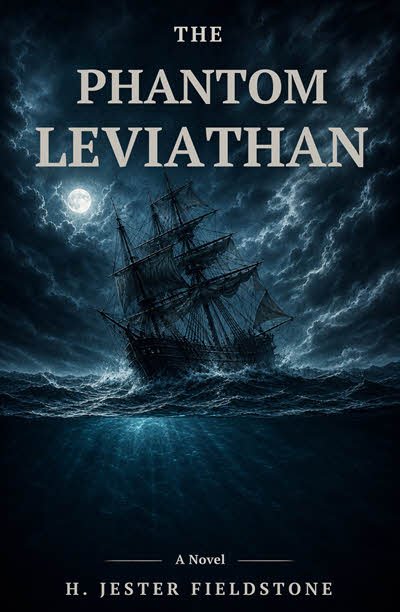
The Phantom Leviathan
Book Three of the H. Jester Fieldstone Trilogy — Historical Maritime Fiction and Political Allegory
Aboard the nineteenth-century sailing vessel The Horizon, Captain Magnus Vane leads his crew in pursuit of a mysterious leviathan. No man aboard has seen the creature, yet Vane's certainty is powerful enough to carry them into dangerous waters, where questioning their captain may prove as perilous as the voyage itself.
Inspired by Herman Melville's Moby-Dick, this dark maritime novel weaves psychological drama, historical adventure, and political allegory into a gripping examination of power, grievance, and collective belief. Through the eyes of young sailor Noah Wake, readers witness how ordinary men surrender their judgment, how doubt becomes betrayal, and how a captain's certainty threatens the lives of everyone who follows him.
The third and concluding book in Fieldstone's thematically connected trilogy, The Phantom Leviathan transforms the political absurdities explored in The Extraordinary Voyages of Donald J. Trump and the psychological forces examined in We Is Trump into a timeless literary allegory.
The voyage begins with an unseen enemy. The real danger may be much closer than anyone aboard is willing to admit.
Explore the Story and Characters of The Phantom Leviathan
The Ideas Behind the Writing
Political movements are made of people, and people seldom behave as predictably as their principles suggest.
They seek belonging, defend cherished beliefs, laugh at their opponents, and sometimes overlook in their own leaders the very faults they condemn in others. Intelligence offers no certain protection against self-deception, and good intentions do not guarantee good consequences.
These contradictions provide much of the material for H. Jester Fieldstone's writing.
Satire allows him to examine the ridiculous without surrendering the serious. Political analysis offers the opportunity to investigate the forces beneath public behavior. Literary fiction places these same concerns in the lives of characters who must act before they fully understand the consequences.
Across all three books runs a curiosity about power: how it is acquired, how it is justified, and why people continue to support it.
The question is not simply why certain individuals seek authority, but what the rest of us are willing to surrender when we grant it.